Cosmos

The operating system
for systems.

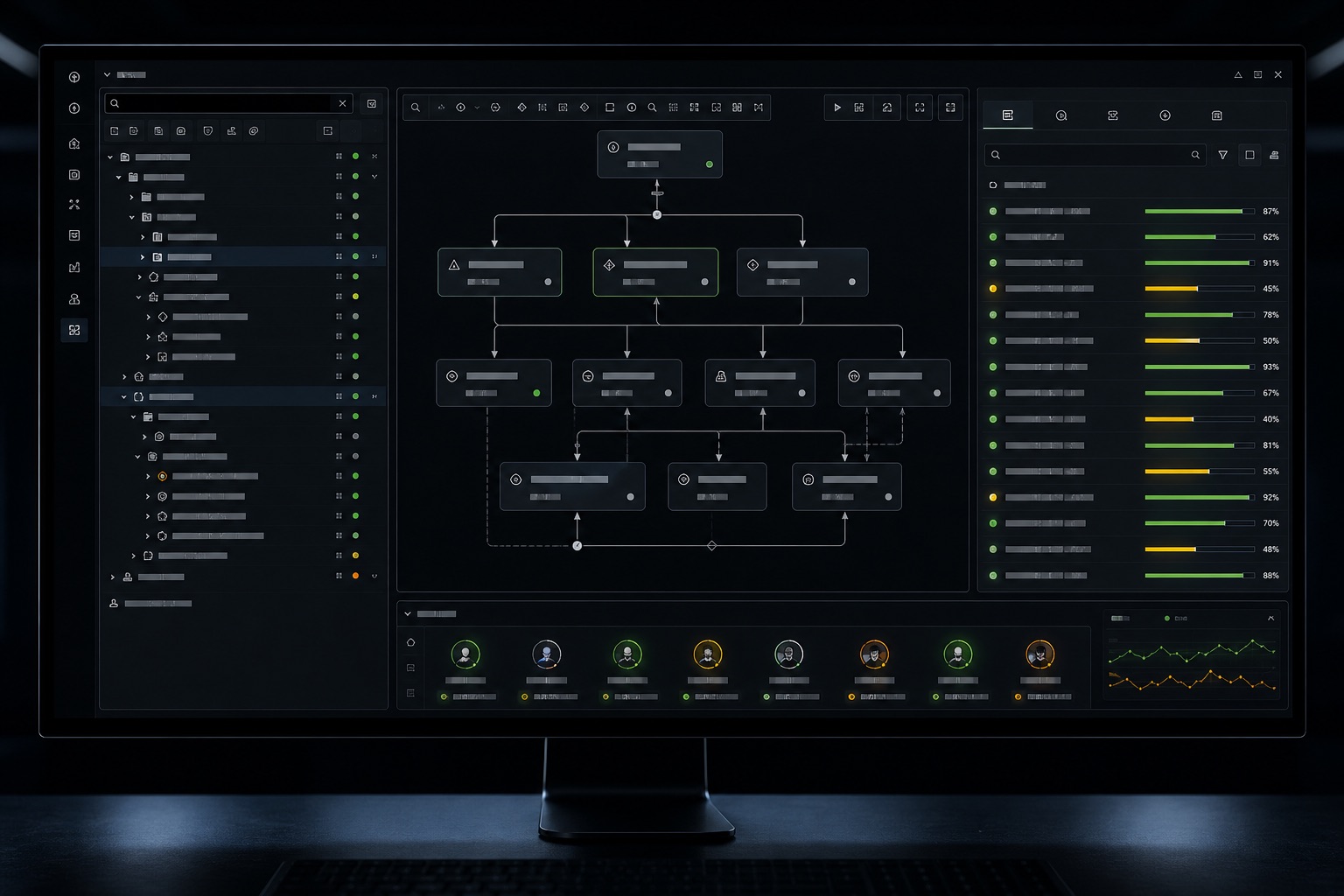
You have the vision and the domain knowledge. Cosmos gives you 13 autonomous AI agents that turn it into running software — planned, built, deployed, governed, and audited. You define what the system should be. AI builds and operates it.


You don't need a better tool.
You need an actual system.

“I have the idea. AI can write the code. But nothing connects it to my vision, my requirements, my deployment.”

How many tools does it take to ship one feature? And which one knows whether what you shipped actually matches what you planned?

Jira tracks tasks but doesn't know your vision. Cursor writes code but doesn't know your requirements. Vercel deploys but doesn't know if what shipped actually works. Each tool covers one step. You cover the seams between them — manually, every day.

The problem isn't that your tools are bad. The problem is that nobody closes the loop. Your requirements say one thing. Your code does another. Your deployment proves a third. Three months in, nobody can tell you whether what you shipped matches what you planned. There is no connective tissue. Cosmos is that connective tissue.


Model it. Generate it. Govern it.

Define your operation as a structured model — capabilities, workflows, requirements, roles, data flows, deployment topology. Software is generated from the model rather than written from scratch and drifted from its design. The model is the source of truth. Everything traces back to it.

01

Articulate

Describe your vision — voice or text. AI refines it, pushes back on scope, and decomposes it into capability baselines with testable requirements. The model becomes the source of truth.

02

Generate

AI agents plan the work, write proposals, execute code changes, and deploy to production. Software is generated from the model — not written ad-hoc and reconciled later.

03

Govern

Three layers of governance. Every execution reviewed by the Analyzer. Every night reviewed by the Watchman. Every week reviewed by you. The model enforces traceability from vision to deployment.

04

Converge

Continuous auditing scores the system against its own goals. AI identifies gaps, generates the work to close them. The system gets measurably better every week — not by accident, by engineering.


13 autonomous agents.
One continuous execution loop.

Not chatbots. Not copilots. AI agents that do real work — plan weekly sprints, write and review proposals, execute code changes, audit quality, investigate failures, triage inbound requests. One engineer manages multiple independent production systems through Cosmos today. That is the leverage the platform provides.

Continuous Execution

An unattended loop — plan, propose, build, deploy, audit — with budget governance controlling when it stops. Not a cron job. A system that drives itself toward the model.

Full Traceability

Vision → capability → requirement → code → test → deployment. Every entity traces to why it exists. Every release proves what it delivered against the model.

Self-Hosting Proof

The ultimate test of a systems engineering platform: can it build itself? Cosmos manages its own development — planning sprints, writing proposals, deploying releases, auditing quality. Every capability you use was built by the same capabilities.

Every Surface

Web, iOS, macOS, Android, and CLI. Approve a deploy from your phone. Dictate a vision from your car. Review a plan from the terminal.


Cosmos is the engine. Constellations are how it meets a domain.

A Constellation is a packaged set of entities, workflows, and logic for a specific vertical. Instead of building from scratch, you compose your Cosmos with Constellations that match your operation. The Helium Constellation is live — powering real industrial gas operations today.

See Constellations →

Your infrastructure. Your terms.

A Station is the hardware that runs a Cosmos. Today, Cosmos runs on AWS. Station is the path to sovereign, on-premise deployment — the box you buy when your critical systems should not be tenants in someone else's building. Plant-floor vocabulary for plant-floor operators.


Built the system that moves
20% of global helium.

One engineer. Multiple independent production systems — enterprise energy logistics, helium operations, industrial gas platforms, a civic campaign platform, and more — all built and managed through Cosmos. Helium proves it models physical operations. The campaign proves it models human ones. The self-hosting proof proves it's general. The same engine works in every domain.


Systems builders and the organizations that need them.

Builders

You see a domain and want to build the system for it

You have the vision and the domain knowledge. Cosmos gives you the engineering discipline and the autonomous workforce to ship it — model your domain, set a budget, govern the outcome. Ship what used to take a team of 20.

Organizations

You need your operation engineered as a system

We deploy Cosmos for organizations that need their operation modeled and run as a real system. We learn your domain, structure it, and deliver — powered by the same engine we use ourselves.


Requirements drift from code.
Code drifts from architecture.
Architecture drifts from vision.

You keep stitching tools together. Every new AI tool adds speed to one step and another seam to the whole. Your competitors ship autonomous systems while you manage integrations. The cost of AI inference drops every quarter — but without a model, it's just a faster way to produce drift. The gap compounds.

Now picture the alternative. You describe what the system should do. AI builds it, deploys it, and audits it against the model. You review the result over coffee — not by reading code, but by reading a convergence report that tells you exactly where the system stands relative to your vision. That is a Tuesday morning with Cosmos.

Get Early Access

Model it. Generate it. Govern it. Converge.

The system that builds itself is the system that builds yours.

Get Early Access